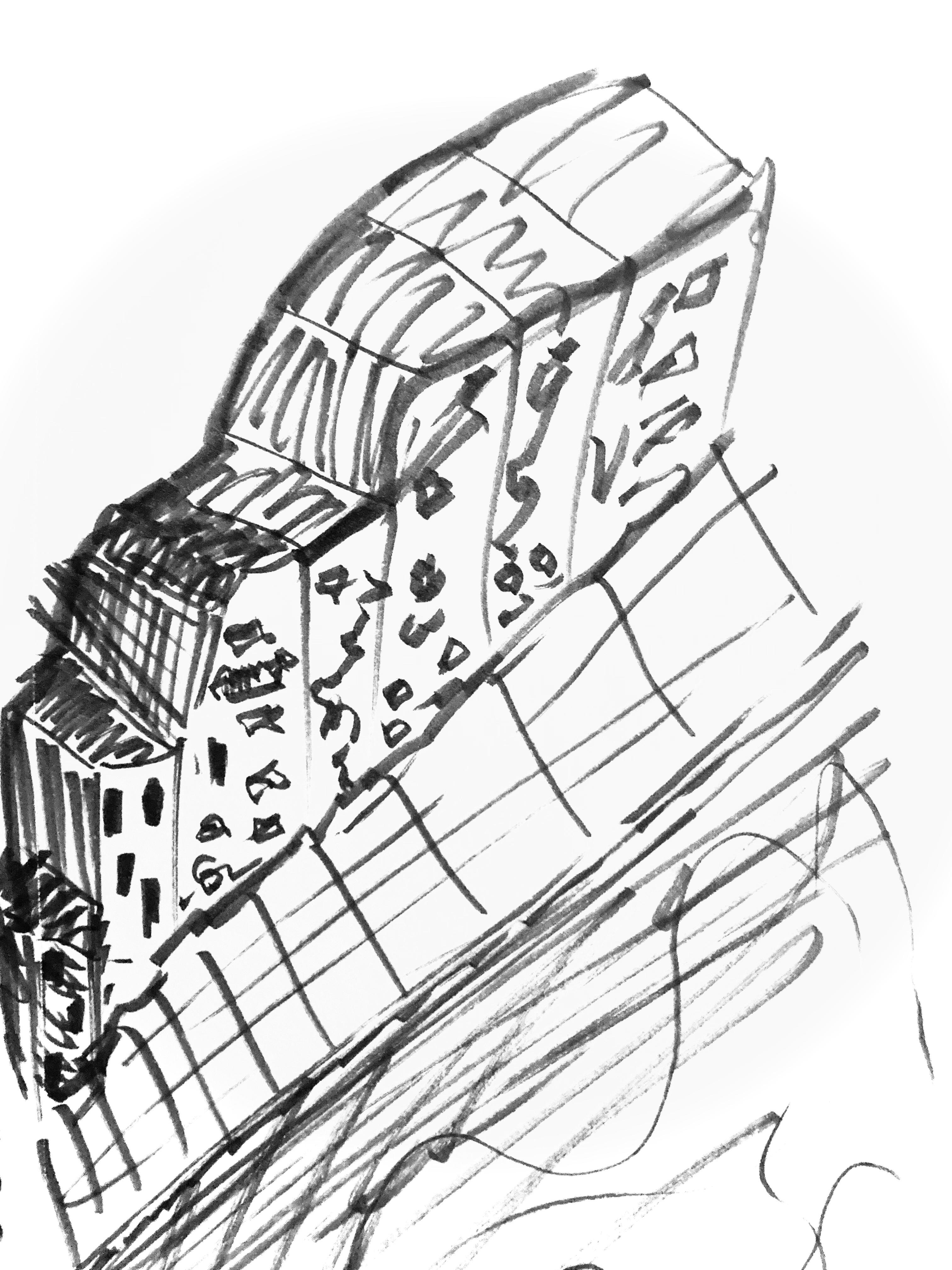
1/18/25 — SOCIETY | STREAM OF CONSCIOUSNESS
I’m scared of goodbyes. I linger long after parties are over and talk phone conversations to death. when I have something, all I can think about is when I won’t. I’m not good at returning to myself. my brain is a messy house I try only to sleep in. I have filled my life with other places to be: in people, in love, and scrolling in between —
It’s the fear of stillness. It’s an addiction to motion. It’s cognitive atrophy. It’s not just me. How good nowadays is at filling our hollow places full. Lost is the art of self-soothing, emotional processing, and regulation. Lost is the world’s ability to force silence on us: a consistently deep contemplation and confrontation with the darkest corners of our minds… the natural order of psychological things.
I wonder if this event is observable in anthropology — of the psychological and cultural variety. I’m doing Google searches for interesting changes in the ways humans emotionally regulated around the neo-subsistence revolution. But I haven’t actually thought about how one might pin down the neo-subsistence revolution in history, so I’m swapping it for the industrial and technological revolutions. Google thinks I’m searching for the advent of telehealth… forget it.
Sometimes I’m dreaming of smashing all my electronics in a sudden frenzy and then relishing in the calm after that storm: waking up to silence, loosing track of time, missing news, deglobalizing because the world is big again (so that it takes a day or two to get to Europe and not just the click of a button), Forgetting about cinema, being it, forgetting about art, making it. This is not a dream. You’re not an alcoholic. You can’t just throw the bottles away. You wish. You wish it was that easy, but they just don’t make trash cans big enough for the culture of overstimulation.
CHARACTERISTICS OF CULTURAL OVERSTIMULATION
What is cultural overstimulation and when was its historical advent? I want to say it’s linked to increased economic activity and so the industrial revolution. We also see a decrease in subsistence agriculture around this time, if I am correct, so that people are becoming increasingly corporate and rushing out of their homes and into urban complexes more often. Companies were abandoning hand made trades for factory assistance in order to meet consumer/population demands. Our dwelling spaces were becoming denser. In response, we manipulated the speed at which human work could be done and encouraged overproduction which encouraged overconsumption so that the modern hamster wheel began to turn…
1) THE ABOLITION OF LOW STIMULATION WORK.
2) COMMUTES.
4) OVERPRODUCTION AND OVER CONSUMPTION.
3) OVERCROWDING AND THE URBAN DESIGN.
5) PERPETUAL BUSYNESS.
They way people thought around this time must have begun to change. There are smoke signals in the neo-classical and modern era of art and literature, after all — in the likes of Wanderer Above the Sea Fog and Frankenstein: art that was close to the ground. In the midst of industrial chaos, the romantics were deemed eccentric for a reason: they were desperate to wallow, feel something, and to remind themselves that they were.
I am struggling to recall a French word I learned in high school while taking IB Literature: Flanuer (with an accent — I had to look it up). It was popularized by a French prose-poet during the French Romantic Era which, similar to American history, also happened to coincide with the French Industrial Revolution1. The flanuer represented an kind of archetype for eccentricity in the newly industrial world: whimsy, strolling, observant, and above all — slow2. I believe he is described as impractical by the mainstream: unemployed and lacking busyness as he wanders through the streets of Paris for the sake of it: l’art pour l’art (the phrase is fitting though it came a bit later in history)3.
These reflections are important for understanding the nature of counterculture at the advent of cultural overstimulation. Contemplation was countercultural largely because freetime/low stimulation work was even moreso. This social conditioning did not end in the modern era but prevailed through the postmodern age as we observe in Virginia Woolf’s A Street Haunting: who’s protagonist has always reminded me of the archetypal flanuer (forgive my English keyboard).
THE ANTHROPOLOGY OF OVERSTIMULATION.
I do not think this is the natural order of things. We have created a culture in which people are scared of their own minds because society does not incentivize spending time with it. People have less time than ever to reflect nowadays as human work is stratified to the end of commercialism instead of subsistence. The natural circadia of human labor is disturbed: it tells us to work past our needs now. We hardly labor in organic settings any more, travel on foot, retrieve/prepare our own food, or make our own garments. These were the moments in which people once listened to their internal monologues, reconciled loss, and learned to entertain themselves. Life could get mundane, but mundanity might actually be vital to the human psyche. It creates a mental space where there is ample room to confront the self. This kind of work was a healthy medium between leisure and hyperproductivity — perhaps lost to the age of subsistence agriculture. As a result, modern and post-modern humanity lacks skills in emotional processing, regulation, coping, esteem, and communication. Above all they lack a sense of self.
I’m scared of goodbyes. i linger long after parties are over and talk phone conversations to death. when i have something, all I can think about is when I won’t. I’m not good at returning to myself. my brain is a messy house i try only to sleep in. i have filled my life with other places to be: in people, in love, and scrolling in between —
It’s the fear of stillness. it’s an addiction to motion. It’s cognitive atrophy. It’s not just me. how good nowadays is at filling our hollow places full. Lost is the art of self-soothing, emotional processing, and regulation. Lost is the world’s ability to force silence on us: a consistently deep contemplation and confrontation with the darkest corners of our minds… the natural order of psychological things.
Nowadays I’m watching a solar system lose gravity and all its planets fall into orbital decay. We all feel like this solar system. Before modernism, people were prone to rejecting their humanity in favor of their personhood4, but nowadays, I think cultural overstimulation ravages that too. Students graduate high school and college feeling inundated and aimless, a record number of people are quiet quitting in the American workplace5, and yet people are only getting busier. Free time causes us to confront the piles of emotional garbage we have left to rot in the corners of our mind, quitting social-media forces us to confront the things we desire distraction from, and we just don’t know how to do it. We never have.
I worry about this because it is a problem for human intentionality within social and political environments. If people are out of touch with both themselves and ultimately the human experience, how can they be entrusted to mold the future of the human world? I think we forget how fundamental this is to all else: that creating an intentional humanity is what makes leisure, art, and investigation absolutely vital to our intrapersonal worlds.
As modernity forges ahead, into discussion of AI legal personhood, the modern version of Dr. Frankenstein’s monster, I choose to step back— into intentionality. Such fundamental questions as “Who Am I?” “What is my role in relation to nature?” and “What is nature?” are increasingly vital to the creation of a world driven to found purpose, solve moral dilemma, and preserve human legacy.6
I do think humans have an instinctually coded labor. I think it’s simple and close to home. I think it makes space for our complex psychology and all the work it requires, I think it makes space for art and creativity, and I think it’s essential to human emotional and motivational health. I think society will get closer to finding it the farther it removes itself from sensory overload.
Summer Arukwer-Strother


 Anthropersonal
Leave a comment